
Diffuser materials · comparison guide
Ceramic vs Plastic Essential Oil Diffusers: Which Is Better?
Choosing a diffuser material affects your collection’s appearance, packaging and shipping costs. Compare ceramic and plastic ultrasonic diffusers by design, durability, customization and everyday use, then explore models that fit your retail or private-label plans.
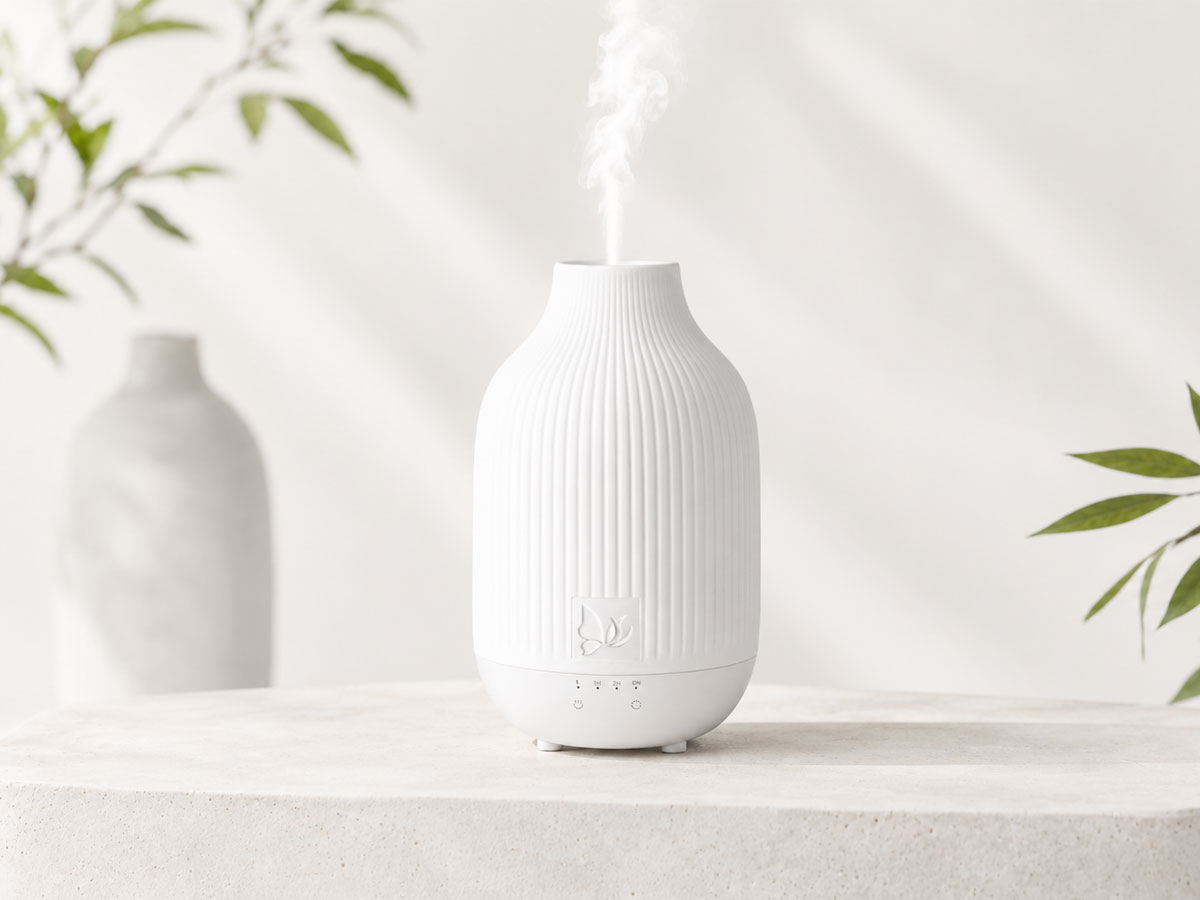
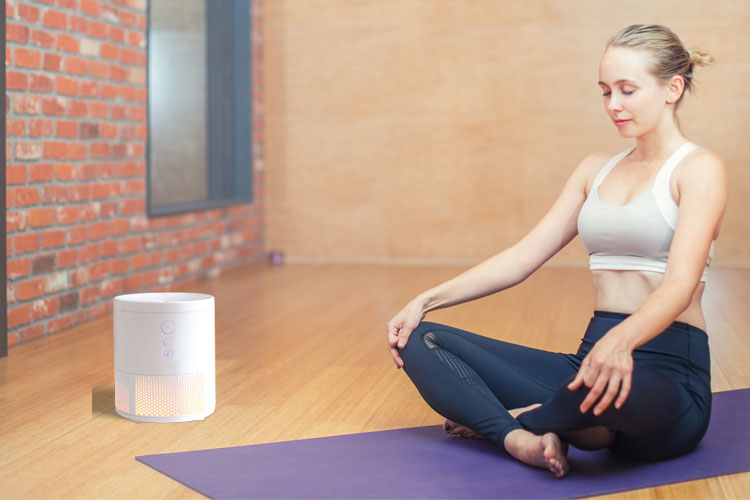
Quick answer
Choose Ceramic for Texture and Décor; Plastic for Lighter Product Ranges
Ceramic suits collections where a tactile finish, decorative shape and gift presentation matter. Plastic often suits lighter products, varied shapes and cost-sensitive ranges. Both can use ultrasonic misting systems. Compare the actual model for mist output, noise, controls and runtime; the outer material alone does not tell you how it will perform.
Ready to see designs? Explore our ceramic diffuser collection or browse the wider ultrasonic diffuser range.
At a glance
Ceramic Diffuser vs Plastic Diffuser
Compare each material against your target customer, retail price, packing requirements and delivery route. The right choice depends on your product range.
| Buying factor | Ceramic diffuser | Plastic diffuser | Procurement takeaway |
|---|---|---|---|
| Visual position | Often selected for tactile, decorative, homeware-style or gift-led presentation. | Can range from basic utility designs to polished, coated or highly styled housings. | Choose by brand position, not material prestige alone. |
| Weight | Typically heavier when the ceramic cover forms a substantial part of the housing. | Typically lighter for a comparable-sized product. | Weight affects carton planning, freight and subscription/gift fulfilment. |
| Breakage risk | The ceramic cover can chip or break if dropped or poorly protected. | Usually more tolerant of impact, although clips, tanks and decorative parts can still fail. | Packaging design matters more for ceramic projects. |
| Surface options | Can support matte, glazed, ribbed, relief, patterned and sculptural directions. | Can support molded texture, colour, coating, wood-look, metallic effects and more complex integrated geometry. | Different production routes create different customization possibilities. |
| Shape flexibility | Form is influenced by ceramic forming, firing, shrinkage and finish requirements. | Injection-molded or assembled plastic structures can support wide shape and component integration options. | New shapes still require feasibility and tooling review for either material. |
| Retail cost position | Often used where appearance can support a more considered retail price and presentation. | Often offers more flexibility for entry-level, promotional or high-volume price points. | Do not compare unit price without including packaging, freight and customization. |
| Mist performance | Depends on the internal ultrasonic system, not the ceramic cover itself. | Depends on the same internal system factors. | Material alone is not a mist-performance specification. |
| Cleaning | Outer ceramic cover and internal water tank may require different cleaning methods. | Tank and housing material must be compatible with the approved cleaning method. | Follow the exact model instructions; do not assume vinegar, alcohol or detergent is universal. |
| Private label | Strong when finish, texture and presentation are part of the brand story. | Strong when colour, functional variety, cost control and scalable model families matter. | Both can work well for private label when the chosen model fits the channel. |
First distinction
The Housing Material and Misting System Are Separate Choices
Many ceramic ultrasonic diffusers have a decorative ceramic cover around a plastic water tank and electrical base. A plastic-bodied diffuser can use the same type of water-based ultrasonic misting system.
Products with different covers can have similar internal systems. Products that look alike can also have different tanks, controls, charging arrangements and mist settings. Review the material for appearance and handling, then compare the model specifications for operation.
Compare the housing for brand position. Compare the internal platform for performance.
Explore the different models in our ultrasonic aroma diffuser collection.
Design & retail positioning
Ceramic Adds Texture to Home-Fragrance Collections
Ceramic is especially useful when a diffuser is expected to sit beside candles, skincare, homeware or decorative objects. A matte, ribbed, glazed or sculptural ceramic cover can help the product read as part of a lifestyle collection rather than as a small electronic appliance.
That can matter for home-fragrance brands, wellness ranges, boutique retail, hotel gifting and subscription products where the unboxing and shelf presentation contribute to the perceived value.
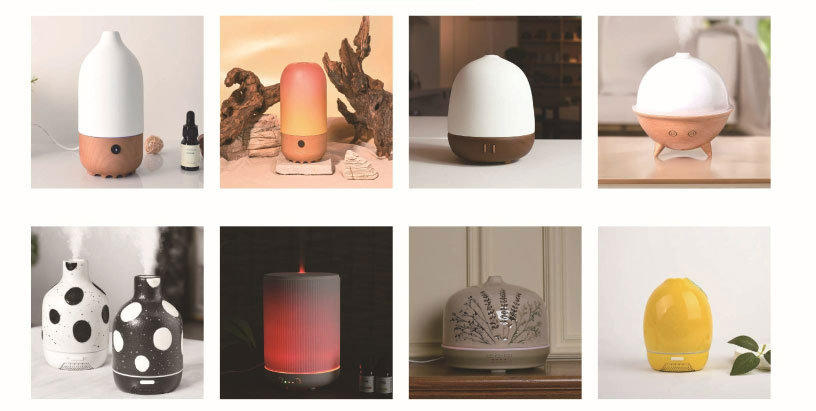
A ceramic example: the white ribbed ceramic diffuser combines a textured cover with a 250 ml water tank, rechargeable battery and Type-C USB charging. Its product page shows the design, branding and packaging options.
Plastic Offers More Than a Basic Finish
Plastic housings can be molded, coated, textured, coloured and combined with wood-look, metallic or translucent components. They are useful when a brand needs more freedom around integrated buttons, vents, light windows, portable formats or a family of models at different price points.
The real design question is therefore not whether ceramic is “better.” It is whether the material supports the intended customer, retail price, photography, packaging and brand language.
If your brand depends on a very specific visual identity, approve the physical surface and finished sample under normal retail lighting. Screens can hide glaze variation, texture, gloss and colour differences.
Durability & logistics
Weight and Fragility Affect Your Packaging Plan
Ceramic's practical trade-off is fragility. A ceramic outer cover may chip, crack or break if the diffuser is dropped or if the retail box does not control movement during transport. This does not make ceramic unsuitable for international wholesale; it simply means protective packaging and sample-based transport review matter more.
Plastic housings are generally lighter and more impact-tolerant, which can help with e-commerce fulfilment, subscription boxes, promotional campaigns and higher-volume programs where freight and breakage rates need close control.
However, plastic products still need proper inspection. Clips, tanks, hinges, light windows, coated surfaces and assembled joints can scratch, warp or fail if the model or packaging is poorly designed.
Ceramic project
Pay extra attention to cover fit, edge quality, visible finish, inner protection, movement inside the box and master-carton handling.
Plastic project
Pay extra attention to molded-part fit, surface consistency, coating or print adhesion, tank integrity, control alignment and cosmetic scratches.
For wholesale projects, the approved sample and written packaging specification should travel together. AromaLeap's diffuser quality-control page covers the broader order-control framework.
Private label & OEM
Customization Works Differently on Ceramic and Plastic
With ceramic, the most visible customization usually centres on colour direction, glaze or matte appearance, texture, pattern, logo application, ceramic shape and coordinated packaging. Some changes may require new molds, firing tests or finish development rather than a simple artwork update.
Plastic platforms often give more freedom to integrate structural details, button geometry, light windows, molded texture, coatings, colour changes or mixed-material assemblies. But new molds, electronics or substantial housing changes still move the project from private label into a deeper OEM/ODM development route.
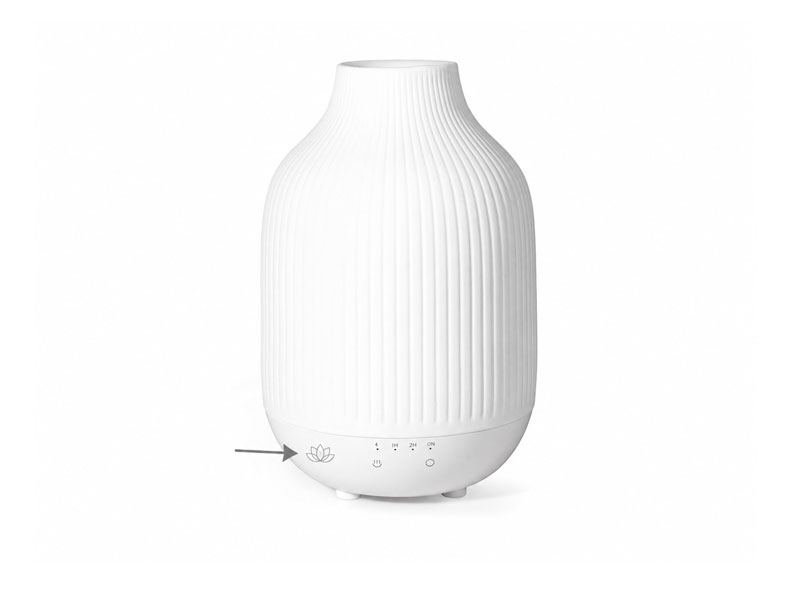
What to Review With Your Sample
- The diffuser model, finish and operating functions.
- Your logo position and appearance on the finished surface.
- The retail box, protective insert, accessories and manual.
- Minimum quantity, production timing and any development work.
For a new housing or broader product changes, explore our custom diffuser service. To understand ceramic shapes and finishes, read how ceramic diffusers are made.
Performance & maintenance
Do Ceramic Diffusers Perform Better Than Plastic Diffusers?
Not automatically. For an ultrasonic diffuser, useful performance questions include tank capacity, atomizing system, mist output, operating modes, airflow, controls, power arrangement, leakage control, sound and low-water behaviour. The decorative material does not replace those specifications.
This is especially important when comparing two supplier quotations. A ceramic product may cost more because of its cover and finish while using a similar internal platform to a plastic model. Conversely, a plastic diffuser may include more complex controls or a larger tank and therefore occupy a different technical and commercial position.
Cleaning also depends on the internal construction
On many ceramic ultrasonic models, the ceramic piece is an outer cover while the water tank and atomizing area are made from other materials. The cover, tank and electrical base therefore may require different handling. Plastic models can also use different tank materials, seals and surface coatings.
Follow the instructions for the exact product. Do not assume alcohol, vinegar, detergent, boiling water or another cleaner is suitable merely because it works for a different diffuser.
Material comparison helps you choose the product position. Model instructions and test data help you choose the operating product.
Materials and product life
Consider the Whole Product When Comparing Materials
A diffuser contains more than its outer cover: the tank, electronics, cable, packaging and any battery also matter. Material sourcing, production, transport and useful life all contribute to its environmental impact.
Ask about the actual materials, protective packaging, available replacement parts and product information. Those details are more useful for evaluating a range than a broad claim based only on ceramic or plastic.
B2B decision guide
Which Material Fits Your Sales Channel?
The strongest material choice is the one that fits the buyer's channel, target price, logistics and brand presentation.
Home-Fragrance & Wellness Brands
Ceramic can be a strong direction when the diffuser needs to sit naturally beside candles, oils, skincare and décor products. Plastic remains useful for entry models or broader functional ranges.
Importers & Distributors
A mixed range often works better than choosing one material only: plastic for accessible volume, ceramic or glass for higher visual tiers, and portable models for specific use cases.
Subscription Boxes
Plastic can reduce weight and breakage risk, but compact ceramic models may justify a higher perceived value if protective packaging and fulfilment economics still work.
Retail & E-commerce
Compare photography, shelf presentation, return risk, carton size, product reviews, maintenance instructions and target retail price—not only material.
Hotels & Spas
Ceramic can fit design-led guest gifting or retail concepts. For operational use, model reliability, controls, cleaning and power-market requirements should lead the decision.
Promotional & Corporate Programs
Plastic or mixed-material compact designs often offer more flexibility for campaign budgets, colour choices, gift boxes and large quantities.
Making your shortlist
Compare Two Samples Before Choosing Your Range
- Appearance: compare the finish, texture and logo in normal lighting.
- Operation: try filling, mist settings, controls and cleaning access.
- Delivery: compare product weight, box size and protective packing.
- Your order: review pricing, minimum quantity, lead time and available documents with the supplier.
Start with the ceramic collection to compare styles, or see the white ribbed rechargeable ceramic diffuser for a specific model. If you’re undecided, ask us to suggest designs for your collection.
Common questions
Ceramic vs Plastic Diffuser FAQ
Is a ceramic diffuser better than a plastic diffuser?
Not universally. Ceramic is often preferred for tactile appearance, décor and premium presentation. Plastic can be better for weight, impact tolerance, model variety and cost-sensitive programs. The internal ultrasonic platform determines much of the actual operating performance.
Do ceramic essential oil diffusers last longer?
Material alone does not determine service life. The ceramic cover can remain visually attractive but may chip or break if dropped. Electronics, atomizing components, tanks, seals, cleaning, power quality and usage conditions also affect product life. Compare the exact model rather than assuming one material always lasts longer.
Are plastic essential oil diffusers safe?
Safety cannot be judged from the word “plastic” alone. Confirm the materials used in oil- or water-contact areas, the electrical configuration, model-specific test documents, operating instructions and intended use. Do not assume every plastic material, oil formulation or cleaning chemical is compatible with every diffuser.
Are all ceramic diffusers ultrasonic?
No. Ceramic describes a material, not a technology. Many decorative ceramic aroma diffusers use ultrasonic water-based mist, while passive ceramic products and other formats also exist. Confirm the operating mechanism for the exact product.
Which material is easier to customize for private label?
Both can be customized, but in different ways. Ceramic projects often focus on finish, colour, texture, pattern, logo and packaging. Plastic projects may offer more integrated shape, colour, coating, control and mixed-material options. Availability depends on the existing model, quantity, tooling and technical feasibility.
Which material is easier to ship?
Plastic models are often lighter and less fragile, which can simplify shipping and fulfilment. Ceramic models can ship successfully in wholesale quantities, but inner protection, retail-box structure, carton packing and handling should be reviewed carefully.
Does ceramic make an ultrasonic diffuser quieter?
Do not assume so. Perceived sound depends on the atomizing system, airflow, fan or pump components, housing construction, vibration control and operating mode. Compare tested sound or a physical sample if noise matters to the project.