
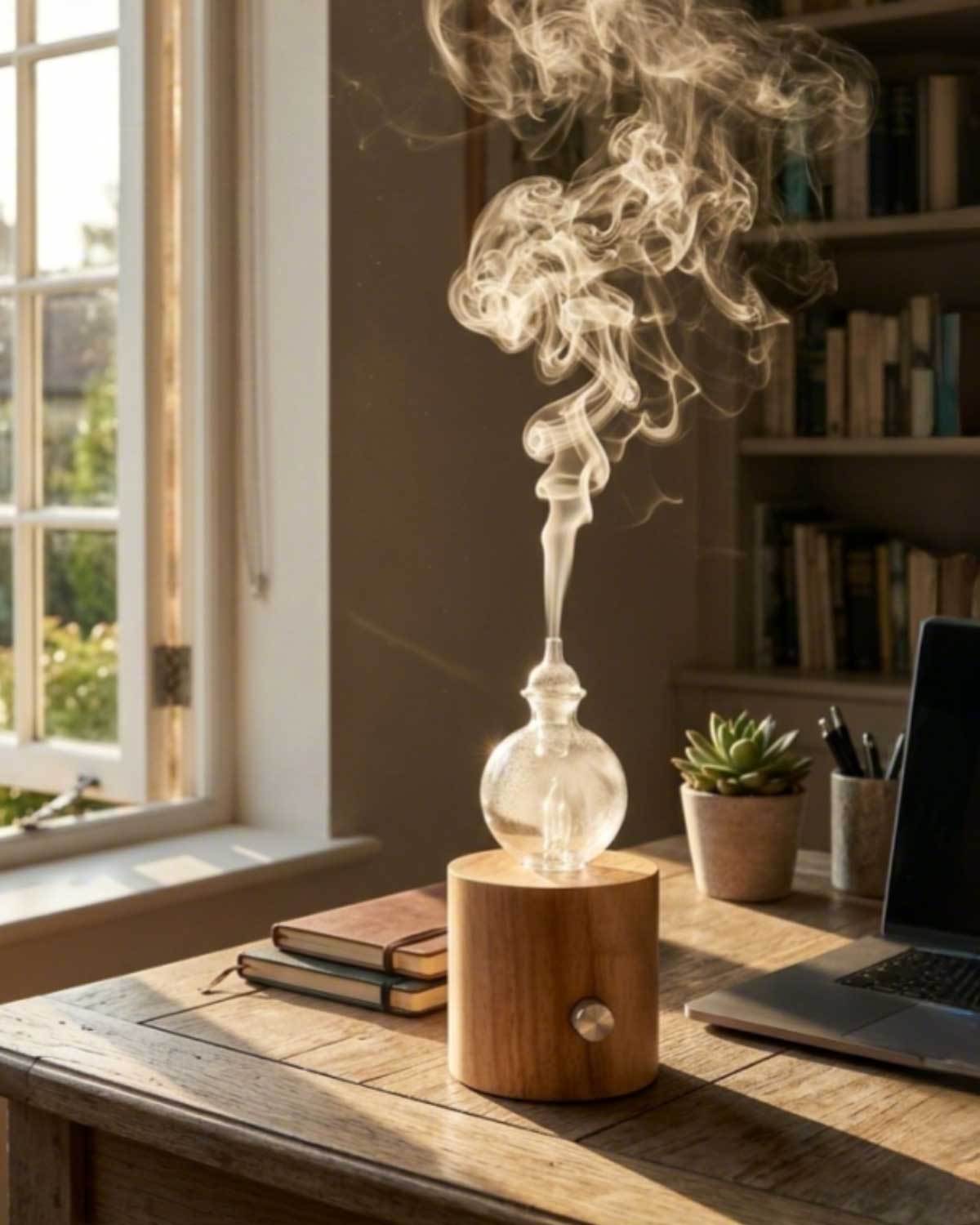
A nebulizing diffuser uses an air pump to move air rapidly across or through a narrow atomizing point. The resulting pressure and airflow interaction draws liquid oil from a reservoir and breaks it into fine airborne droplets. Unlike an ultrasonic aroma diffuser, it normally does not need a water tank.
Key Takeaways
- The diffuser creates an aerosol of liquid droplets; it does not boil the oil into steam.
- Airflow, nozzle geometry, oil viscosity and cleanliness all influence mist quality.
- Classic glass nebulizers and enclosed two-fluid systems use related pneumatic principles but different product architectures.
- Direct-oil output can smell more concentrated than water-based ultrasonic mist, but oil use, sound and cleaning requirements may also be higher.
What Is a Nebulizing Diffuser?
A nebulizing diffuser is a scent-diffusion device that atomizes an essential oil or another compatible liquid fragrance formulation using moving air. In the classic glass design, the oil sits in a glass reservoir and rises through a narrow liquid pathway toward the atomizing point. In enclosed commercial designs, a bottle, straw, nozzle and pump may perform the same basic job inside a protective housing.
The word nebulizing is sometimes used broadly in the home-fragrance industry. For precise product selection, buyers should distinguish between a decorative glass nebulizer, an enclosed two-fluid atomizer and other waterless diffuser technologies. They may all avoid a water tank, but their internal parts, oil compatibility and maintenance procedures are not identical.
Glass also describes a material rather than one fixed operating method. AromaLeap’s glass aroma diffuser guide explains how glass housings, reservoirs and covers can be used with either ultrasonic or direct-oil technologies.
The Main Parts Inside a Nebulizing Diffuser
Designs vary, but most pneumatic nebulizing systems include the following functional elements:
1. Air Pump
The pump supplies the airflow that powers atomization. Pump construction, mounting and isolation affect pressure stability, operating sound and vibration.
2. Oil Reservoir, Bottle or Cartridge
The oil source may be a visible glass reservoir, a removable bottle, a straw-fed container or a sealed cartridge. The container and its seals must be compatible with the intended formulation.
3. Liquid Feed Path
A narrow tube or channel carries oil toward the atomizing point. Its diameter, length, alignment and cleanliness affect how reliably oil reaches the airflow.
4. Air Nozzle and Atomizing Point
This is the critical interaction zone. Fast-moving air meets the liquid and breaks it into droplets. Small changes in geometry can alter suction, droplet formation and spray consistency.
5. Mist Outlet or Diffusion Chamber
Some designs release mist directly. Others use a chamber or glass structure to separate larger droplets, return excess liquid to the reservoir and allow finer droplets to exit.
6. Controls and Duty Cycle
Buttons, timers or programmed intervals regulate how long the pump runs and rests. This helps manage fragrance intensity, oil consumption and perceived sound.

How a Nebulizing Diffuser Works, Step by Step
-
The pump starts moving air
An electric pump sends air through a narrow line toward the atomizing assembly.
-
Air accelerates through a restriction
As air passes through the small nozzle or restricted passage, its local speed rises and the pressure conditions around the liquid inlet change.
-
Oil is drawn toward the atomizing point
The pressure difference and moving air help pull liquid through the feed tube. Capillary action and the physical arrangement of the oil path can also contribute.
-
Air shears the liquid into droplets
At the meeting point, the air stream stretches and breaks the liquid into droplets. This is pneumatic, or two-fluid, atomization: one fluid is air and the other is the oil formulation.
-
Larger droplets are separated
In many glass nebulizers, larger droplets strike the inner glass and return to the reservoir. Finer droplets continue through the outlet into the room.
-
The control cycle repeats
The diffuser may run continuously or alternate between operating and rest periods, depending on the model and selected setting.
A nebulizing diffuser does not “evaporate” all of the oil at once. It repeatedly feeds, atomizes, separates and releases droplets while the pump is running.
What Do Bernoulli’s Principle and the Venturi Effect Have to Do With It?
Many product descriptions say that nebulizing diffusers work through Bernoulli’s principle. That is useful shorthand, but it is not the whole engineering explanation.
When air accelerates through a restricted passage, the local static pressure can decrease. This pressure difference can help draw liquid toward the faster air stream. The term Venturi effect is often used when the restriction and pressure change are created by a narrowed flow passage.
However, the diffuser still needs the air-liquid interaction to break the oil into droplets. Pump output, nozzle dimensions, liquid-feed alignment, surface condition, oil viscosity and formulation all influence whether the mist is stable. Two products can therefore claim the same general principle and still perform very differently.
Nebulizing vs. Two-Fluid Enclosed vs. Ultrasonic Diffusers
The correct diffuser depends on the formulation, application and user experience. The table below compares common characteristics without assuming that every model behaves identically.
| Feature | Classic Glass Nebulizer | Enclosed Two-Fluid Atomizer | Ultrasonic Diffuser |
|---|---|---|---|
| Main medium | Compatible oil used directly | Compatible oil used directly | Water plus a compatible quantity of oil |
| Mist formation | Pneumatic atomization in a glass structure | Pump, straw or bottle and atomizing nozzle | High-frequency vibration creates water-based mist |
| Scent character | Often concentrated and immediate | Often direct and adjustable | Usually softer because the oil is dispersed with water |
| Water reservoir | Normally no | Normally no | Yes |
| Typical sound source | Air pump and airflow | Air pump, motor and airflow | Fan, electronics and water movement |
| Maintenance focus | Glassware, feed tube and atomizing point | Bottle, straw, nozzle, seals and oil pathway | Water tank, ultrasonic plate and scale control |
| Best suited to | Decorative aromatherapy products and concentrated direct-oil scenting | Portable, protected or commercial product formats | Quiet, longer-duration water-based misting and familiar mass-market use |
For a broader direct-oil product range, see AromaLeap’s waterless diffuser manufacturer page. For wholesale, OEM or private-label nebulizing models, visit the nebulizing diffuser manufacturer & wholesale page. Readers comparing terminology can continue with the informational guide Diffuser vs. Nebulizer.
What Changes a Nebulizing Diffuser’s Performance?
Oil Viscosity
Thicker or resinous oils may move more slowly through narrow tubes and may require more frequent cleaning. A formulation that works in one nozzle design may not behave the same way in another.
Residue and Formulation Ingredients
Carrier oils, waxy components, suspended material, oxidation products and incompatible solvents can interfere with the feed path, nozzle, seals or bottle connection. This is why compatibility testing matters for both essential oils and fragrance oils.
Airflow and Pump Stability
Weak or unstable airflow may reduce atomization. Increasing the output setting may improve scent intensity, but it can also increase operating sound and oil consumption.
Nozzle Geometry and Alignment
The size and position of the air and liquid openings influence suction and droplet formation. Manufacturing tolerance, assembly accuracy and contamination at the atomizing point therefore matter.
Duty Cycle and Placement
Intermittent operation can moderate scent intensity and consumption. Room volume, doors, ventilation, air-conditioning and placement affect how the fragrance travels and how strong it feels.
Why people choose nebulizing diffusers
- No water reservoir in most designs
- Direct and often stronger scent delivery
- Distinctive glass, wood and decorative formats
- Useful specialist story for aromatherapy brands
What users must manage
- More frequent cleaning with some oils
- Potentially higher oil consumption
- Audible pump or airflow
- Fragile glass parts in classic designs
How to Use and Clean a Nebulizing Diffuser
Always follow the instructions for the exact model. The sequence below is a practical framework, not a substitute for the supplied manual.
Before Use
- Confirm that the intended oil or fragrance formulation is compatible with the diffuser.
- Place the unit on a stable, level surface away from edges and direct heat.
- Fill the marked reservoir or install the approved bottle without exceeding the stated level.
- Start with a lower or intermittent setting and assess the room before increasing output.
During Operation
Observe the mist pattern, sound and oil pathway. Stop the diffuser if you notice leakage, repeated sputtering, unusual pump noise or a sudden reduction in output.
Cleaning
- Switch off and disconnect the diffuser before removing user-serviceable parts.
- Remove remaining oil according to the product and formulation instructions.
- Clean only the parts and pathways identified in the manual, using the approved cleaning liquid and method.
- Allow the parts to dry as instructed, reassemble carefully and test with a small quantity of compatible oil.
What Brands Should Test Before Ordering a Nebulizing Diffuser
For a brand or importer moving from technical research to supplier evaluation, a sample should be tested with the actual intended oil—not only with the supplier’s demonstration liquid. Review atomization stability, sound, leakage, oil consumption, cleaning access, glass protection, replacement parts, packaging and destination-market documentation.
This article explains the technology. For commercial model selection, OEM/private-label options and wholesale enquiries, use AromaLeap’s nebulizing diffuser manufacturer & wholesale page.
For structured production checks, read AromaLeap’s diffuser quality and inspection guide. Buyers sourcing compatible fragrance formulations can review the diffuser oil wholesale page. Projects requiring coordinated branding, finishes or packaging can continue to the custom aroma diffuser service.
Frequently Asked Questions
Does a nebulizing diffuser use water?
Most classic glass and enclosed pneumatic nebulizing diffusers use a compatible oil directly and do not require a water reservoir. Confirm the operating instructions for the exact model.
Does a nebulizing diffuser use heat?
The atomization process normally relies on moving air rather than heating the oil. Electrical components may still generate some normal operating warmth, depending on the design.
What role do the Bernoulli and Venturi effects play?
Air accelerated through a restricted passage can produce a lower local static pressure, helping draw liquid toward the air stream. The moving air then breaks the liquid into droplets. Pump output, nozzle geometry and liquid properties also matter.
Is nebulizing mist a vapor?
More accurately, it is an aerosol of liquid droplets suspended in air. The device atomizes the oil mechanically rather than boiling it into steam.
Can fragrance oil be used in a nebulizing diffuser?
Only when the diffuser supplier and formulation supplier confirm compatibility. Viscosity, solvents, carriers, suspended material and residue can affect atomization, seals and cleaning.
Can thick essential oils clog a nebulizing diffuser?
Thick, resinous or residue-forming oils can restrict narrow tubes or nozzles. Test the intended oil and follow the approved cleaning procedure.
Why can a nebulizing diffuser sound louder than an ultrasonic diffuser?
A nebulizing diffuser relies on an air pump or motor, so pump vibration and airflow may be audible. Housing design, isolation, placement and room acoustics affect perceived sound.
Do nebulizing diffusers use more oil?
Direct-oil atomization can consume oil faster than a diluted ultrasonic system, especially at higher output or longer operating cycles. Actual consumption depends on the model, setting and formulation.
How often should a nebulizing diffuser be cleaned?
Follow the interval for the exact diffuser and oil. Clean sooner when using viscous or residue-forming formulations, changing oils, storing the unit or noticing reduced output.
Is a nebulizing diffuser better than an ultrasonic diffuser?
Neither is universally better. Nebulizing models suit users who want concentrated direct-oil scenting. Ultrasonic models may suit quieter operation, longer water-based misting and broader mass-market familiarity.
Ready to Move From Research to Supplier Evaluation?
If you are sourcing for a brand, retail program or hospitality project, review AromaLeap’s commercial nebulizing diffuser range before requesting samples or a quotation.
View Nebulizing Diffuser Manufacturer & Wholesale Options →